Winner - SOM Outstanding
Occupational Health Team 2025
Occupational Health Team 2025
Our Brands


September 18, 2026
Occupational Health Awareness Week (21–27 September 2026) exists partly to answer a question that should have an obvious answer but often doesn't: what does an occupational health professional actually do?
The Society of Occupational Medicine, which organises the week, wants to build wider understanding of what OH contributes to workplace health, and to encourage more healthcare professionals to consider it as a career. The second aim is the harder one. Occupational health sits at the intersection of clinical medicine and the world of work, yet many clinicians go through years of training without properly encountering it. Ask a newly qualified doctor, nurse or physiotherapist what an OH career involves, and the answer is often vague: something to do with sickness certificates, workplace medicals, or HR.
Dr Stuart Scott has spent more than 25 years finding out how much more there is to it. As Chief Medical Officer at TAC Healthcare, and before that in senior medical roles across the energy and remote-healthcare sectors, his career has taken in general practice, offshore medicine, telemedicine and organisational medical leadership.
Before occupational health, Stuart worked as a salaried out-of-hours GP with G-MED and NHS Grampian, mostly within the Emergency Care Centre at Aberdeen Royal Infirmary. He then held medical leadership roles at Capita Health & Wellbeing, Iqarus and International SOS, before joining TAC Healthcare as Chief Medical Officer in 2023.
His move into OH wasn't part of a plan. “While working as Clinical Director for eHealth at NHS Grampian, and as an out-of-hours GP, I started doing sessions at Capita Energy Medical Services and found the clinical variety of OH fascinating,” Stuart says. “I moved into OH full-time in 2011.”
Part of the reason is exposure. Medical and nursing training is built largely around hospital placements and primary care rotations, and OH services often sit outside those settings. Where clinicians do encounter OH, it's usually as a referral pathway or a policy requirement rather than somewhere they see clinicians working, so it tells them little about what the job actually involves.
“It rarely features in the undergraduate curriculum,” Stuart says, “and few people get properly exposed to the full range of OH services, or the clinical challenges the specialty brings, during postgraduate training.”
The most persistent misconception is that OH is mainly administrative: signing people off, signing people back on, running through medicals. Some of that is part of the job. None of it is the whole picture. OH clinicians specialise in how a person's condition affects their ability to work safely, and how the work itself affects their health, a judgement that shifts considerably with the environment.
“People don't always understand the range of clinical knowledge required to accurately assess an employee's fitness for task,” Stuart says, “how OH clinicians work collaboratively with employers to support the fitness of their workforce, or the variety of experience the role can offer.”
Having worked in both general practice and occupational medicine, Stuart is well placed to describe what changes when a clinician moves between them. General practice centres on the individual patient and the next consultation. OH asks a broader question: not just what's wrong, but what it means for someone's ability to stay in work, and it asks clinicians to think at a population level, advising organisations on risk across an entire workforce rather than one patient at a time.
Few medical students picture themselves eventually advising clinicians offshore or supporting saturation divers, but Stuart's career has covered both. At International SOS he was Medical Director for Scotland, advising offshore operators, drilling contractors and vessel operators, with clinical responsibility for UK occupational health services, offshore medic training and the organisation's global MedDive service. He has also written on telemedicine for offshore and remote healthcare, co-authoring a paper on the business case for shipboard telemedicine published in International Maritime Health in 2013, and currently advises BP North Sea on clinical strategy for offshore operations and global expatriate teams. It's one example of how far the specialty can stretch: into remote medicine, technology, and sectors most clinicians never consider.
None of this breadth counts for much if the specialty can't attract and keep enough people to deliver it. OH also isn't solely a medical specialty. It's delivered by nurses, physiotherapists, occupational therapists, psychologists, occupational hygienists and technicians, each bringing different expertise to the same question of how health and work interact.
“The profession needs to emphasise the positives,” Stuart says: “the clinical variety, the office hours, and the development opportunities to focus on specific areas of interest.”
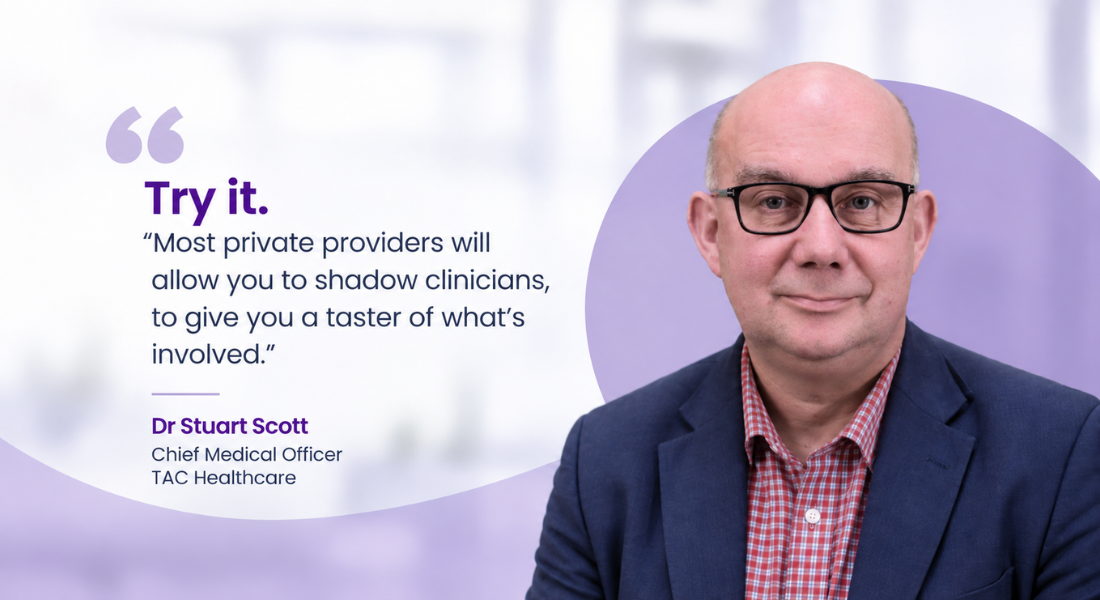
“Try it,” Stuart says. “Most private providers will allow you to shadow clinicians, to give you a taster of what's involved.”
Occupational Health Awareness Week is as much a chance to widen understanding of this profession among the clinicians who might one day join it, as to explain its value to the workplaces it serves. For many healthcare professionals, occupational health simply isn't on the list of careers they were shown. It probably should be.
Explore careers at TAC Healthcare.
Find out more about careers in occupational health through the Society of Occupational Medicine.